
Special reportsIn-depth analysis of the week
Solar, batteries, vehicles: is the Chinese wave reshuffling Africa's energy deck?
In 2026, Africa is installing solar panels at an unprecedented pace, importing more batteries than modules, and watching its electric vehicle sales double. Almost all of it comes from China. Behind this boom, funded largely by households and businesses, lie critical challenges: blind statistical tracking, waste, weakened power utilities, and a local industrial base struggling to keep up. As African Energy Week draws to a close in Cape Town, Gisement takes stock.
Current landscape: massive flows, finally quantified
Solar first. Chinese panel exports to Africa reached 23 GW over the twelve months ending June 2026, up 53% year-on-year. Africa now carries as much weight as other major emerging markets: over the same period, China exported 23 GW to Africa, 23 GW to the Middle East, and 25 GW to Latin America.
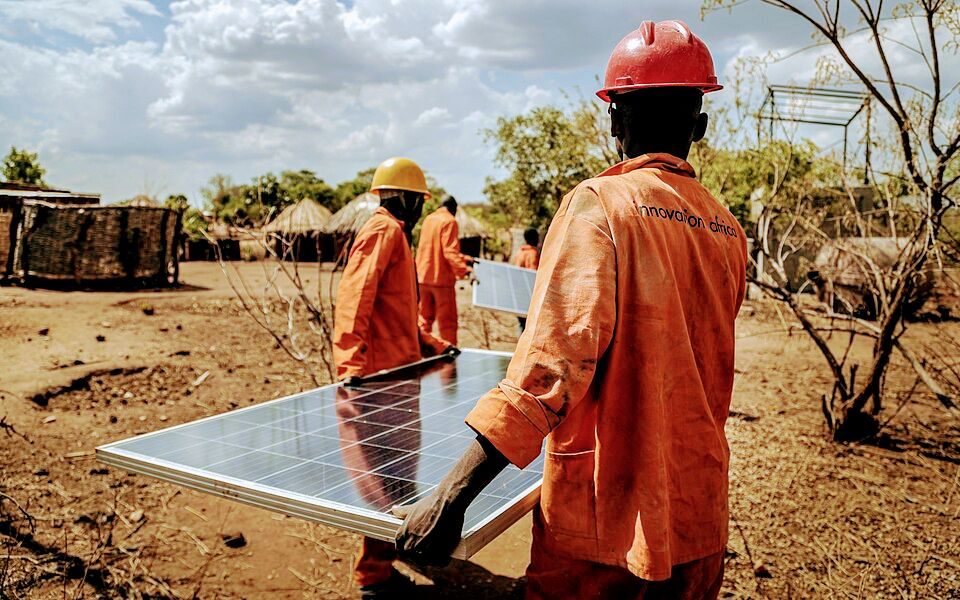
According to think tank Ember, Africa will install 17 GW of solar capacity across the whole of 2026—a 45% increase, following a 51% rise in 2025 and 25% in 2024. That equates to roughly 100,000 panels installed every day. Dependency is nearly total: only 6% of installed panels were manufactured on the continent, with the remaining 94% coming from China.
The boom is no longer an exclusively South African story. In 2023, 52% of African solar imports went to South Africa; by June 2026, that share had dropped to 20%. Six countries have emerged as gigawatt-scale markets: South Africa (3.3 GW expected in 2026), Egypt (2 GW), Nigeria and the DRC (1.7 GW each), Algeria (1.4 GW), and Morocco (1 GW). In total, 36 of Africa's 54 countries are expected to deploy record volumes in 2026.
Next, batteries—the most underestimated segment. Since 2024, Africa has imported more batteries than solar panels from China by value: in two years, panel exports doubled, while battery exports quadrupled. Nigeria and the DRC are the leading markets. In Nigeria, batteries are primarily used by households and businesses during load shedding to replace diesel; in the DRC, they notably power solar-plus-storage systems at copper mines.
Finally, mobility. Electric vehicle sales in Africa more than doubled to surpass 30,000 units in the first half of 2026. In South Africa, Chinese models now account for roughly 90% of new electric vehicle sales. Yet the shift is most pronounced on two wheels: African imports of Chinese electric motorcycles and three-wheelers surged by 60% in the first half of 2026 to $114.6 million, led by Morocco, Egypt, and Algeria. Electric motorcycles already represent about 20% of sales in Uganda and 15% in Kenya.
Why it works: diesel as a deterrent
The engine of this boom can be summed up in one word: diesel. The Chinese panels imported over twelve months cost $2.4 billion; generating that same electricity with diesel generators would cost roughly the same amount in fuel every three months. The war involving the United States and Iran, along with subsidy removals in countries like Nigeria and Egypt, have sent pump prices soaring. Geopolitical shocks have also triggered buying sprees: in March 2026, Nigerian demand jumped 519% compared to February, reaching 1.2 GW, while Ethiopia imported 1.1 GW.
The deployment model is decentralised. Ember estimates that 75% of solar capacity added in Africa between 2023 and 2025 falls under distributed solar, predominantly installed on rooftops. Commercial and industrial (C&I) clients are leading the charge, accounting for at least 80% of distributed capacity in most markets, with paybacks of two to five years. The local economy is adapting accordingly: 370 new solar companies were registered in Nigeria in 2025, nearly seven times more than in 2019.
Chinese pricing remains unbeatable, even as it edges up slightly. On 1 April 2026, China eliminated its 9% export VAT rebate, raising panel prices by 4% to 8% and improving the competitiveness of African-made modules.
On trade, Beijing has broadened its tariff-free access. From 1 May 2026 through 30 April 2028, China is granting duty-free treatment to 20 non-least developed African nations, after extending zero tariffs to 33 African LDCs in December 2024. While this measure opens the Chinese market to African exports, it does not on its own redress the trade structure in which Africa primarily imports high-value-added finished goods.
Blind spots: governments flying blind
The first challenge: nobody is accurately tracking what is happening on the ground. Ember estimates African solar additions at 12 GW in 2025, compared to 6.2 GW reported by the International Energy Agency (IEA) and 4.6 GW by IRENA. Only 36 out of 54 countries publish official figures on solar capacity, and just 14 did so for 2025. The fallout is real: the African Union's Continental Power System Masterplan targets 23 GW of solar by 2040—less than the 26 GW installed over the past three years alone. A government unaware of what sits on its rooftops risks overinvesting in redundant utility-scale power plants.
The second challenge: power utilities. South Africa offers a case in point. Eskom sold 178 TWh during its 2026 financial year, a 6.2% drop, led by a 22.5% slump in industrial demand. The utility estimates behind-the-meter solar in the country at 9.1 GW. Energy analyst Chris Yelland describes it as a classic utility death spiral: falling demand forces tariffs up, which in turn accelerates customer defection. Ember points to the social repercussions: every large commercial customer leaving the grid takes away revenues that subsidise low-income households, and self-generation costs two to four times more than utility-scale capacity.
The third challenge: quality and e-waste. According to the NGO SolarAid, roughly 150 million solar products have been distributed across Africa since 2010, and nearly 75% are believed to be out of service. A literature review estimates that off-grid solar waste in Sub-Saharan Africa reached 12,000 tonnes in 2020—up 545% from 2016—handled mostly through informal recycling practices with severe environmental impacts. In Malawi, researchers from the University of Manchester identified hazardous lead pollution levels linked to the informal recycling of lead-acid batteries from solar systems. The massive influx of lithium batteries exacerbates the threat: lithium-ion battery recycling facilities are virtually non-existent in Sub-Saharan Africa.
Moving up the value chain: factories, but for whom?
Africa is manufacturing more, but not for its own consumption. African module assembly capacity is projected to quadruple in 2026 to around 3.5 GW, up from 800 MW in 2025; however, these modules are primarily destined for the United States, where tariffs on Chinese goods keep prices elevated.
Egypt represents the most advanced case. Commissioned in January 2026 in Ain Sokhna, EliTe Solar’s $115 million complex combines 2 GW of cells and 3 GW of modules, employing around 800 people, roughly 700 of whom are Egyptian. The ATUM Solar project, backed notably by JA Solar, is the only initiative committed to sourcing local glass and aluminium. In Tanzania, the model is more fragile: the facility is limited to module assembly on relocated legacy lines using Chinese cells. Crucial value-chain links remain absent: no solar glass is produced in Africa, and all balance-of-system components are imported.
Customs data also reveals significant transit trade. China exported 19 GW of cells and 9 GW of wafers to Africa over two and a half years, compared to just 2.7 GW of modules assembled on the continent; Ember views this largely as transshipment, presumably destined for the US.
Nigeria exemplifies the pitfalls of bans. The government announced plans to ban solar panel imports, a move deemed premature by the Lagos-based Centre for the Promotion of Private Enterprise (CPPE), which argued that such a policy would deepen the energy crisis given insufficient domestic production. Facts lend credence to this concern: the Rural Electrification Agency (REA) estimates domestic capacity at 300 MW, while flagship projects remain stalled—from Tranos's 800 MW plant, which is still not operational, to the 1 GW Solarge-InfraCorp hub, which lacks both a site and active construction.
In batteries, Morocco is emerging as a pioneer, backed by Chinese capital. Gotion High-Tech's plant in Kénitra is billed as the first gigafactory of its kind in Morocco and the Middle East and Africa region. It is scheduled to start at 20 GWh per year and ramp up to 100 GWh across five phases, generating roughly 2,300 direct jobs in phase one. Yet here too, the focus is external: Morocco’s Investment Minister stated that 85% of production will be exported. Other manufacturers, predominantly Chinese, are clustering around Gotion.
The status quo could shift. Fresh US tariffs on solar cells and modules take effect on 1 December 2026. According to Ember, this could redirect African-made panels to local markets, replacing Chinese imports. A window of opportunity is opening, provided governments are prepared to seize it.
Energy cooperation: from Cape Town to concrete outcomes
African Energy Week took place in Cape Town from 12 to 16 October 2026 under the theme "Invest in African Energies: Affordable and Abundant Energy Additions". Organisers reported over 10,000 attendees. Run by the African Energy Chamber, the event serves primarily as a deal-making marketplace, spanning upstream oil and gas to renewables.
China’s presence is expanding, but the African Union (AU) is setting its own benchmarks. During a meeting in Beijing in January 2026, the AU representative to China stressed that the success of Sino-African cooperation should be judged not by the dollar value of headline pledges, but by tangible progress in industrialisation, infrastructure, cross-border grid links, and human capital.
On regional interconnections, some milestones have been reached. In Ethiopia, the Ayesha II wind farm, built by a Chinese group, will supply power to Djibouti via a cross-border industrial and electricity corridor. Yet the boom in distributed solar confronts regional planners with a fundamental question: does relying on centralised national grids still make sense? Ember argues that solar-plus-storage allows African nations to leapfrog the traditional national grid model, favouring generation close to consumption backed by leaner transmission systems designed for system balancing.
Recommendations: turning an unmanaged boom into strategy
Several policy levers emerge from these findings.
Measure before planning. At least 15 African nations are drafting distributed solar registration procedures, and South Africa has rolled out a digital portal used by over 55 municipal distributors to geolocate every system. This data is essential for recalibrating utility investment plans and tariffs.
Enforce standards and structure end-of-life management. Senegal offers a viable model: the national renewable energy agency, ENDA Énergie, and the École Polytechnique de Thiès have established a testing and certification laboratory alongside a pilot recycling facility, preparing for over 22,000 tonnes of PV waste anticipated by 2040. Extended producer responsibility (EPR) should be made mandatory for importers.
Favour phased incentives over outright bans. The Nigerian experience demonstrates that import bans without local manufacturing capacity drive up power costs without building factories. Tiered customs duties on components, concessional finance, and public procurement commitments offer a more effective path.
Negotiate local reciprocity with Chinese investors. Mandatory local content, skilled employment, technology transfers, and local input procurement—modelled on ATUM’s pledges in Egypt—must become standard practice rather than exceptions.
Reform electric utilities. Rather than penalising behind-the-meter generation, utilities must integrate distributed solar into their grids and adjust tariff structures to safeguard subsidies for vulnerable households.
Conclusion
Africa is experiencing a bottom-up energy transition, funded by its own households and businesses, enabled by Chinese industrial overcapacity, and accelerated by diesel price shocks. The near-term outcome is positive: more electricity, fewer fuel imports, and reduced load shedding. Yet without robust data, standards, and an industrial roadmap, the continent risks serving merely as an end-market for foreign manufactured goods—and their eventual scrap. The window opened by Sino-American trade frictions and rising Chinese export prices will not stay open indefinitely. The priority now is to convert low-cost imports into long-term industrial capability, avoiding the trap of a new technological dependency.
Sources
- Face à la Chine, la France et l’Espagne défendent des stratégies industrielles différentes (Le Monde)
- Le dessous des cartes : l'essentiel (Programme TV Ouest-France)
The free Gisement newsletter
Every morning, Africa’s mining, oil and energy headlines in your inbox.

Comments
To comment, please use the French edition of this article.