
Oil: Brent climbs back above $111 as the shadow of $126 looms over Africa
Brent crude climbed back above the $111-a-barrel threshold this Thursday, 22 October, driven by an expanding tanker war stretching from the Strait of Hormuz to the Gulf of Oman and a global diesel shortage. It remains well below the $126 record high touched in April. But for Africa, which produces crude and imports refined fuels, every dollar counts double. A $111 barrel brings back the ghost of April.
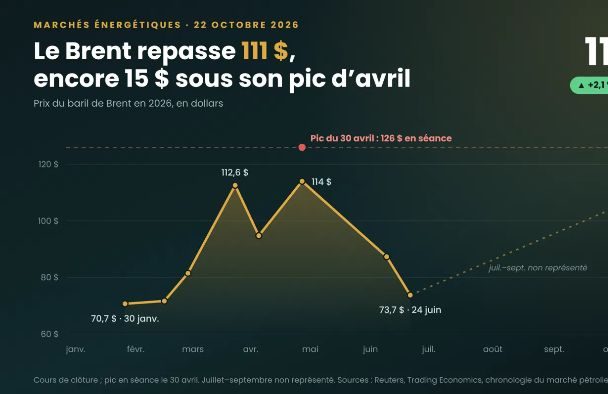
This Thursday, Brent is trading around $111.1, up approximately 2% on the day, according to Trading Economics. On Tuesday, 20 October, it had already touched $111.99 in intraday trading, its highest level since May, before closing at $108.79.
The $126 figure is circulating nevertheless. It does not describe today's market: it is the intraday peak reached on 30 April 2026, at the height of the Hormuz blockade, before a close at $114 (oil market chronology). There is still a $15 gap between current prices and that record.
The gap matters less than the trajectory. Over one month, crude has gained nearly 8%. Over a year, it has risen by about 70%.
At sea, the tanker war shifts ground
The danger is no longer confined to the Strait of Hormuz. Analytics firm Kpler has recorded at least 18 vessel attacks in two weeks. According to LSEG analysts, Iran is now targeting tankers as far as the Gulf of Oman.
This week, Iran's Islamic Revolutionary Guard Corps claimed that naval mines disabled three tankers, and a vessel was reportedly hit off Oman. On land, a drone attack on Saudi Arabia's Shaybah field left two dead, and Yemen's Houthis claimed strikes against Aramco facilities, including Yanbu.
The paradox: oil continues to flow. Kpler estimates crude flows through Hormuz last week at around 8.5 million barrels per day, close to their pre-war levels. But transport is becoming increasingly costly: ING points to record freight rates in the Persian Gulf. As ANZ analyst Daniel Hynes summarizes, producers take the risk "because there is no other route" for their crude (OilPrice).
Refining: diesel is the real bottleneck
Crude is moving, refined fuels much less so. Since late spring, global refining capacity has dropped by up to 10%, or 6 to 8 million barrels per day, according to the Federal Reserve Bank of Dallas (Dallas Fed).
The causes are compounding. Ukrainian drones knocked out up to 60% of Russian refining capacity this summer. Iranian strikes cut Middle Eastern refineries by 2 million barrels per day. China has banned diesel exports. As a result, the crack spread between crude and diesel prices has exceeded its 2022 record.
Washington is on the front lines. Diesel there is selling for an average of $6.32 per gallon, a record. "We are talking about reopening every refinery possible," Energy Secretary Chris Wright said. The United States also temporarily lifted sanctions on Russian diesel, and the G7 announced on 2 October the release of 100 million barrels from strategic reserves (Guttman Energy).
For Europe, the Dallas Fed considers the diesel shortage even more severe than in the United States. Africa depends on these very supply chains: according to Kpler, Saudi Arabia supplied about 40% of the diesel imported by the continent in 2025, and Russian deliveries to West Africa plummeted from 330,000 to 54,000 barrels per day between June and July (S&P Global, cited by Agence Ecofin).
Mining: metals retreat, energy bills climb
On the mining front, the oil shock is not benefiting metals. Gold was trading at $4,120 an ounce on 20 October, down 5.5% over one month (Fortune). Copper is quoted at $6.44 a pound this Thursday, down 3.5% over one month, after a record $6.85 in September. Strikes and severe weather in Chile are supporting copper; speculation over a potential drop in US tariffs on refined copper is dragging it down.
For African mines, the real issue lies elsewhere: energy costs. Many gold operations in the Sahel and copper sites in the Zambia-DRC belt operate off-grid, running on diesel generators and heavy equipment powered by gasoil. With diesel costing nearly twice as much as crude, producer margins are shrinking even as metal prices fall.
Africa: a continent cut in two by the barrel
The crisis is redistributing wealth within the continent itself. Between March and August 2026, Africa's nine exporting countries took in $21.6 billion more than a year earlier. Over the same period, the 32 importing countries paid $21.9 billion more for their fuel, according to the Centre for Research on Energy and Clean Air (CREA), cited by L'Œil d'Afrique. For the continent as a whole, the net impact is nearly zero; for each country individually, it is substantial.
Winners
Gain ($bn)
Losers
Additional cost ($bn)
Nigeria
7.5
Egypt
5.2
Angola
4.5
South Africa
3.5
Libya
3.3
Morocco
2.2
Algeria
2.8
Tanzania
2.1
Kenya
1.7
March to August 2026 compared to March to August 2025. Source: CREA.
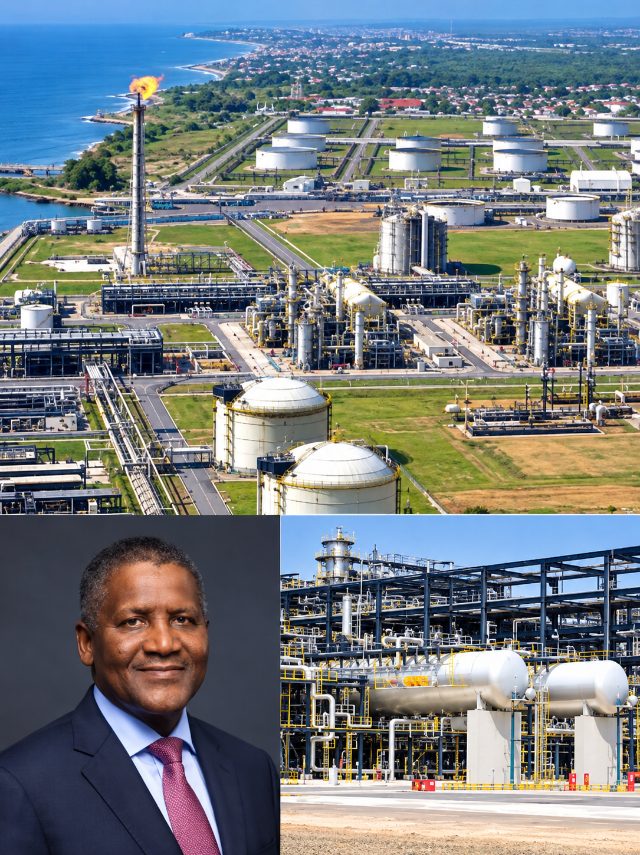
The worst may lie ahead. In its 14 October report, the International Energy Agency (IEA) warned that "gasoil prices could rise again in the coming weeks" in Africa, primarily due to maritime shipping costs. It cited Nigeria's Dangote refinery as a partial buffer for West Africa.
In Côte d'Ivoire, the government already raised pump prices in May and then on 1 August: premium gasoline rose from 875 to 905 CFA francs per litre, and diesel from 700 to 725 CFA francs. Prices remained frozen in September and October. Transport operators, meanwhile, are already considering revising their fares. The November price schedule, expected at the end of the month, will show whether the state can still absorb the shock.
Ten months of a roller coaster
Starting from $70 in late January, crude surged with the war against Iran, peaked in late April, then dropped back below $75 in late June before climbing again this autumn.
What to watch
• The Gulf of Oman. If attacks become entrenched there, freight and insurance costs could push crude back toward its April highs, even with the Strait of Hormuz open.
• Mediation with Tehran. Rumours of a Qatari or Pakistani initiative were enough to cause Brent to retreat on Tuesday; analysts consider a deal "very far off".
• Diesel more than crude. The IEA does not anticipate inventory rebuilding before the second half of 2027.
• Côte d'Ivoire's November pricing schedule, to be published at the end of the month by the Directorate General of Hydrocarbons.
The 2026 crisis is a reminder of a truth Africa knows all too well: producing oil does not shield against an oil shock as long as you do not refine enough of it yourself.
The free Gisement newsletter
Every morning, Africa’s mining, oil and energy headlines in your inbox.
Comments
To comment, please use the French edition of this article.